
Date: March 17, 2026
The Electrical Machines and Drive Systems (EMDS) Laboratory at Kyoto University of Advanced Science (KUAS) conducted an interactive teaching and demonstration session for visiting high school students, introducing them to the fundamentals and applications of linear actuator systems. The session was organized as part of an outreach initiative to inspire interest in engineering and provide students with exposure to real-world laboratory environments.
During the session, students were introduced to the basic principles of linear motion systems, including the operation of electric linear actuators, control mechanisms, and their role in modern engineering applications. The demonstration covered how electrical energy is converted into controlled linear motion, highlighting key components such as motors, drive mechanisms, and feedback systems.
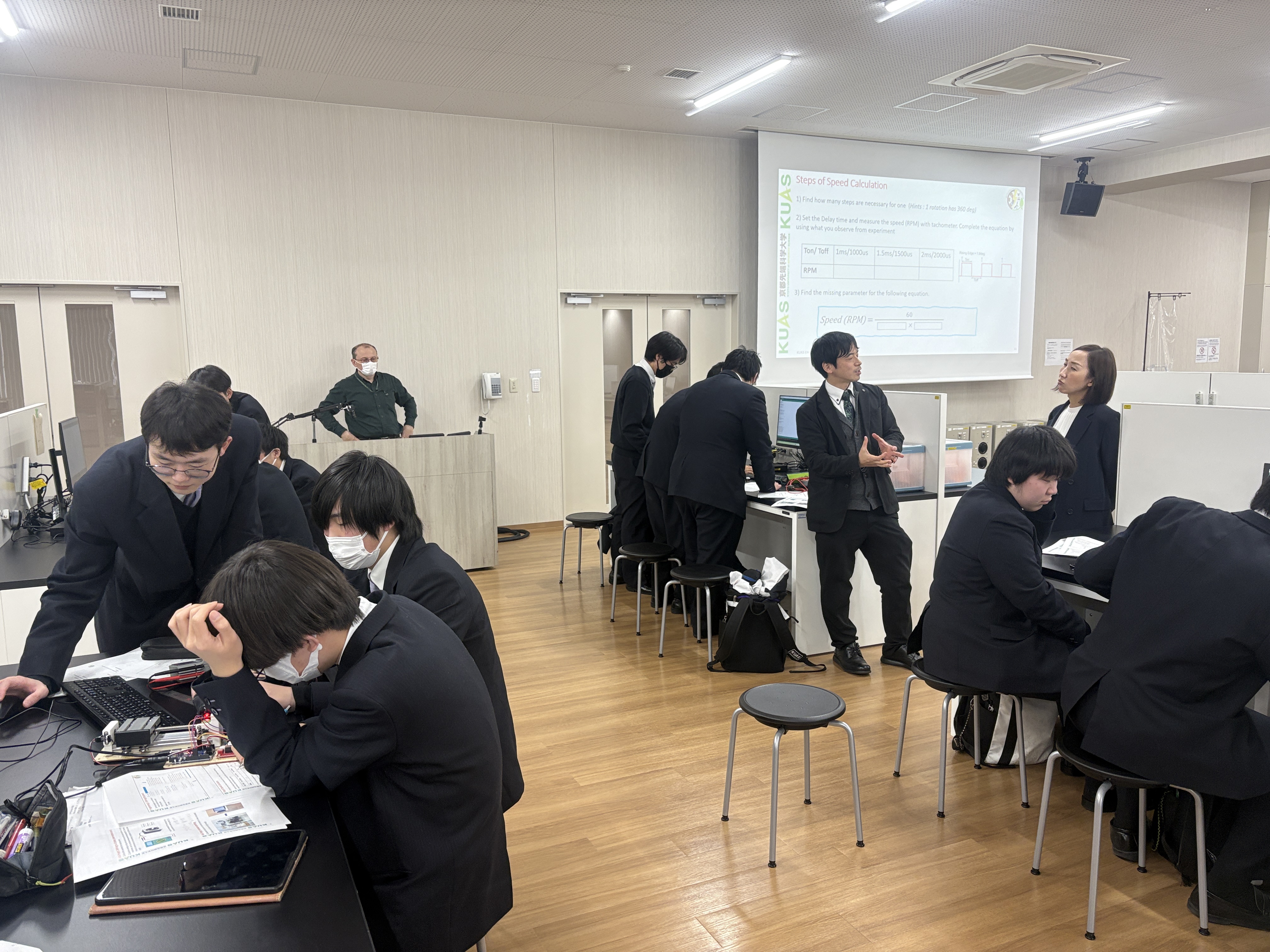
To enhance understanding, the session included live demonstrations using laboratory equipment, allowing students to observe the behavior of linear actuators under different operating conditions. Concepts such as position control, speed variation, and load response were explained through practical examples, making complex engineering principles more accessible and engaging.
In addition to technical explanations, the session emphasized the wide range of applications of linear actuator systems, including their use in industrial automation, robotics, transportation systems, and renewable energy technologies. Students were encouraged to ask questions and interact with the equipment, fostering a hands-on learning experience.

This activity provided a valuable opportunity for the EMDS Laboratory to engage with future students and promote interest in electrical and mechanical engineering fields. The laboratory hopes that such initiatives will inspire young learners to pursue studies in engineering and contribute to the development of innovative technologies in the future.